Sunday, January 19, 2025
NSPower installing 180kW EV chargers in 23 locations
Saturday, November 11, 2023
The Canada Greener Homes Grant likely won't end in March 2024
The Greener Homes Grant provides homeowners with up to $5,000 in rebates for energy efficient upgrades. Shortly after it was announced in 2021, NRCan received tens of thousands of applications, and wait times for an energy assessment grew to several months. As someone who enjoys sharing my knowledge and experience, I decided to obtain a license from NRCan to do home energy assessments.
The program funding is $2.6 billion, which was initially expected to last until 2027. However due to the popularity of the program, and due to the amount of the average grant being higher than expected, the program may end in March 2024. This was announced by NRCan on 2023-11-09 during a service organization town hall meeting.
Anyone who gets an initial energy assessment done before the program end date will still be eligible for the grant. I think it's possible, and even likely, that additional funding will be provided to the program. Whether that funding comes before March, and whether the grant amounts will remain the same, is more questionable.
Instructions for how to find a service organization and book an energy assessment are on the Greener Homes Grant site.
2023-12-09 Update:
I contacted my MP, Kody Blois, and he called me back to discuss the Greener Homes Grant. He said climate change initiatives continue to be a top priority for the Liberal government. Kody said he spoke with Jonathan Wilkinson, Minister of Energy and Natural Resources. Kody said Minister Wilkinson confirmed they will "recapitalize" the Greener Homes grant.
Sunday, August 20, 2023
Solar PV 101
In most parts of Canada, with the benefit of the Greener Homes Grant, the payback period is less than 10 years. And with the Greener Homes Loan, homeowners with good credit can get 0% financing for the full cost net of rebates.
A single solar panel will produce 400 to 600 Watts of power when facing the sun on a clear day. For comparison, a microwave running on full power consumes about 1200 watts. Inverters convert the direct current power from the panels to 120/240 volt alternating current used in the house. Most homes would need at least 20 panels to provide for all of their power needs, though there may not be enough room on a southerly-exposed roof for that many panels.
Since batteries are costly, most homeowners will set up net metering with their power utility. The inverters will send unused power on sunny days to the grid, and the homeowner will get credit to use that power at a later time. A reasonably-priced 5000 watt system will cost around $13,000, while a 10,000 watt system will cost around $22,000. Considering the time required for electrical permits and inspections, system installation time is about two months.
Solar system prices over the long term have been dropping, however the global chip shortage and shipping backlogs caused prices to increase during 2021 and 2022. Prices have started to come back down, and system costs will likely reach a new low in 2024.
Tuesday, February 21, 2023
Gas and Electric Car CO2 Emissions in Nova Scotia
Electric vehicles are often referred to as zero-emission vehicles, however that's a bit misleading when the electricity comes from burning oil and coal. In places like British Columbia and Quebec, where most generation is hydroelectric, EV emissions are close to zero. Considering coal still plays a large part in in the Nova Scotia generation mix, I decided to compare the CO2 emissions of gas and electric cars.
According to NSPower 2021 reporting, each kWh of electricity produced results in 603 grams of CO2 emissions. Canada's most popular electric cars are the Tesla models 3 and Y, the Ford Mach-E, and the Hyundai models Kona and Ioniq 5. According to NRCan, it takes an average of 18 kWh of electricity to drive these vehicles 100 km. Since EV chargers and batteries are not 100% efficient, about 10 to 15% of the grid power will be wasted as heat. Assuming 12% losses, the CO2 emissions can be calculated as:
18 kWh/100km * .6 kg CO2 per kWh * 1.12 loss factor = 12.1 kg/100km
Referring again to NRCan, the average new car with a gasoline engine has a fuel efficiency of 8 L/100km. Burning 1L of gasoline produces 2.3 kg of CO2, so the CO2 emissions can be calculated as:
8 L/100km * 2.3 kg/L = 18.4 kg/100km
This means a gas-power car produces about 50% more CO2 than an electric car charged from the NS grid. Nova Scotia is slowly reducing the amount of oil and coal used for power generation. If you don't want to wait, the quick way to get to zero emissions is to install solar PV panels to generate enough power to charge your vehicle.
Thursday, December 29, 2022
Solar PV costs should drop in 2023
Monday, February 19, 2018
2018 heating costs in Nova Scotia
This year I created a spreadsheet to make it easy to recalculate heating costs. The cost of heating oil is up about 20c/L, and prices for wood pellets have dropped from around $6/bag to $5-$5.50/bag, making pellets a much cheaper source of heat than oil.
For heat pumps with an average COP of 2.0, heating costs are slightly higher than pellets. A high-efficiency ductless heat pump purchased in the last few years will often have an average heating season COP of around 2.5, making the cost for 1000 BTUs of heat around 1.8c. While that price might seem good to people in Eastern Canada, it's very expensive when compared to the cost of heating with natural gas in Alberta. Delivered prices after taxes for residential dwellings is under $5/GJ, making the cost for 1000 BTUs of heat around half a penny!
The outlook for Alberta is that cheap natural gas prices will continue for years to come. While we on the East coast may laugh at Albertans having to endure bitter cold compared our milder winters, they'll have the last laugh when their heating bill comes.
Tuesday, December 19, 2017
HRV? You need one like you need a hole in the wall.
An air-to-air heat recovery ventilator (HRV) can be found in most Canadian houses built in the last 10 years. The theory behind their use is that natural air ventilation rates are not sufficient for good indoor air quality, and an air exchanger without heat recovery wastes energy. Although the second part is true, the first part is not. HRVs add $1,500-$2,000 to the cost of a new home, and are often a source of additional heat loss, even when not in use.
For many years I've been saying air tightness is of utmost importance in homes. According to research done in 2007, Canadian homes built after 1991 had an average air tightness of 3.6ACH@50Pa. Even with improved construction practices in the past ten years, most new homes being built in Canada today would be better off without a HRV. Most new houses have enough natural air ventilation to maintain good air quality during the coldest parts of winter. Many actually have too much natural ventilation, causing unhealthy low levels of humidity. The supposed need for HRVs is based on the ventilation rates in CSA standard F326. The ventilation levels in F326 seem to be based on bad assumptions and wide margins of error, rather than basic science. That's despite the fact that NRCan published reports analyzing indoor ventilation requirements as far back as 1969.
What I find a bit surprising is that building engineers are aware of this issue. Several years ago a senior ASHRAE member told me, "It is widely acknowledged that continuously ventilating houses at F326 rates can results in the houses being over ventilated". Perhaps what is not as widely known is that even "tight" houses with air infiltration rates of 2ACH@50Pa will have high enough natural ventilation rates during the coldest parts of winter. This is not just based on theory, but also indoor CO2 and humidity testing done by myself and others.
I suspect this is not a concern for most people in the HVAC industry since homeowners can just turn off their HRV in the winter. Besides the unnecessary cost of the HRV, what that ignores is the heating loss from a HRV, even when it is turned off. The ducts installed for the HRV often go in and out of attic spaces, which are sources of air leakage unless they are perfectly sealed. Standard HRV designs use only a single damper to block off either the exhaust or fresh air intake when the HRV is not running. This means the HRV adds a six-inch unobstructed hole to the building penetrations. A thermal infrared scan I recently performed clearly shows the heat loss from an exterior HRV duct.
Since removing HRVs is not a viable option, homeowners should at least turn them off during the winter. To avoid heat loss through the outside vents, I tape over the hood opening. I might even leave the vents taped off all year long, and just use a bathroom exhaust fan. Although I'll loose the benefit of heat recovery, when the outside temperature is only 10-15C different than the inside, that heat loss rather modest.
Sunday, April 2, 2017
Sizing and pricing a ductless split heat pump
It's been over two years since I first wrote about mini-split heat pumps. In that post I explained a bit about how to size a heat pump, and now I'll go into more detail. Most installers will use rather unscientific rules of thumb, so I suggest doing the calculations to get a more accurate estimate of your heating needs. Also, the biggest benefit in heating cost stavings comes from installing one system. When two systems are installed, the second system will rarely provide the same amount of savings as the first. If the first system saves you $800 per year in heating costs, adding a second might only save you $400 more.
I've shown a power usage report for a house in Nova Scotia with electric resistance heating and no air conditioning. Other utility companies should provide similar information with their billing. The report shows that minimum daily use is 15-16kWh per day. This would be power use from the electric hot water heater, household appliances, and lights. Subtracting this from the wintertime peak of 122kWh per day gives 106kWh per day of electricity demand related to heating. Since 1kWh = 3412 BTU, the house requires 106 * 3412 / 24hr = 15070 BTU/hr of heating. The house will have some upgrades done such as additional attic insulation and air sealing, so the average January heating demand will be less than 15,000 BTU/hr. The layout of the subject house is reasonably open, so single ductless split with a heating capacity of one ton (12,000 BTU/hr) at -15C will probably be able to provide more than half of the heating requirements.
One-ton mini-splits appear to be the most popular units for residential installs in Nova Scotia, with 1.5 ton the next most popular. Installed prices for a top brand name (Fujitsu, LG, Mitsubishi) one-ton unit are typically between CAD $3,000 and $4,000 plus sales tax. For the subject house the installation is rather simple, with a short vertical run for the line set from the outside unit to the inside air handler. After searching ads on kijiji and asking for referrals, I obtained a quote for CAD $3000 + tax to install a LG LA120HYV system. It has a maximum heating capacity of 13,720 BTU at -15C and 15,650 BTU at 0C, requiring 1.57kW of power for a COP of 2.92. This means the cost of one BTU from the heat pump is about one third of the cost of one BTU from an electric resistance heater. With electricity costs of 15c/kWh in Nova Scotia, I estimate the LA120HYV system will save $1,500 per year.
While installed prices for a top brand heat pump generally start at $3000 and they are usually only sold as installed packages, systems from Chinese manufacturers Gree and Midea can be found for under $1000. If was buying for my own home where I could install and maintain the system, I'd choose a much cheaper (lower-efficiency) Midea system. For example, a nominal one-ton Rheem-branded mini-split system manufactured by Midea sells for $799 at my local Home Depot.
I'll note that making technical comparisons of mini-split heat pumps is a very difficult process. Finding engineering manuals for cheap systems from Midea is almost impossible. For the high-end brands, despite marketing about their quality and efficiency, many don't publish the engineering data on their web sites to back up those claims. Between Fujitsu, LG, and Mitsubishi, LG is the only one (as far as I could tell) that makes their engineering manuals readily available on their web site. For Fujitsu, I had to call their technical support to request an engineering manual for their RLS3 series. A local Fujitsu dealer I spoke to justified the higher prices of the Fujitsu units by claiming they are more efficient than LG, but he didn't have any numbers to back up the claim. The specs on the LA120HYV1 show that it is slightly more efficient than the Fujitsu 9RLS3. The Fujitsu does have a bit higher output than the LG (15.4 vs 13.7k BTU @ 5F), so at 13.7k BTU of output the Fujitsu might be a bit more efficient. Given the installed cost of the LG is much less than the Fujitsu, I think the certainly of lower capital costs trumps the possibility of slightly lower operating costs.
If you are doing your own comparisons, take note of the difference between the actual and rated (advertised) capacities. Industry standards require that a heat pump advertised as a 12,000 BTU model must be able to output at least 12,000 BTU at an outdoor temperature of 47F (8.3C). System's like Fujitsu's RLS3 series and LG's HYV1 will output much more than their rated capacity, and even output their rated capacity down to -15C or colder. LG's lower-cost HSV4 series however only outputs 69% of their rated capacity at -15C.
Addendum - beyond the numbers
Avoid installing too much capacity, such as putting two 1.5 ton systems in a small house (something I have seen in my own neighborhood). Modern split heat pump systems are variable capacity, meaning they will reduce their heat output before they shut off. A system that has an output of 16,000 BTU at 0C may reduce it's output to 8,000 BTU before shutting off. However if it only stays on for 15-20 minutes before turning off, and then turns back on 5 minutes later, it might never enter a defrost cycle. Depending on how intelligent the controls are, this may not be a problem for some units, but I have heard of this happening with Daikin, Fujitsu, and LG units.In snowy climates the outdoor units should be sheltered from blowing snow, or raised high off the ground. When snow blocks the fan blades on the compressor unit, it can blow a fuse on the fan controller board, or fry the control board if it has no fuse.
Saturday, January 14, 2017
High natural gas prices in the Maritimes
Twenty years ago, natural gas exploration near Sable Island promised economic development as well as cheap, clean (compared to oil and coal) energy. For about a decade, those promises came true, but things changed about five years ago. Sable Island gas production was dropping, and new wells like Deep Panuke were not producing as expected. So while gas production in the eastern US has boomed, keeping prices below CAD$4/GJ, prices in Nova Scotia have more than doubled.
In addition to the high market prices for natural gas, Heritage Gas charges a delivery fee (BEC) of $8.18/GJ. That is quadruple the ~2/GJ delivery fee charged by ATCO. A year ago when the total cost for a residential customer was over $20/GJ, heating with oil was significantly cheaper than gas. Although prices in January of 2017 are lower than they were a year ago, natural gas is not a cheaper option than oil for home heating.
One liter of heating oil produces about 0.038GJ when burned. With current prices of around 75c per liter, heating oil costs about $19.74/GJ. While that is slightly more than the variable cost of natural gas, when the fixed cost of $21.87/mth is factored in, natural gas becomes much more expensive. For a three-person residence constructed in the last 30 years that uses natural gas for heat and hot water, annual consumption should be around 75GJ. With 75GJ/yr of consumption, after adding the fixed monthly cost, the total cost for gas comes to $21.50.
Unless Heritage significantly reduces the delivery fee, I think natural gas is likely to remain noncompetitive compared to oil. LNG deliveries to Canaport will likely keep prices below $15/GJ, but the days of cheap natural gas in the Maritimes are now long gone.
Monday, December 28, 2015
Oil cheaper than pellets in NS
Market conditions in the northeast have brought wholesale heating oil prices as low as US$1.10 per gallon. Although heating oil usually sells for more than gasoline since it generates more heat when burned than gasoline, it has been trading for 10-15c per gallon less than gasoline over the past couple months. High inventories combined with a milder than average winter so far have caused a supply/demand imbalance that has pushed prices low.
Just after I wrote my last heating cost comparison, CBC ran an article about a shortage of pellets. Continued strong export demand for pellets (probably fueled by the low Canadian dollar) has kept pellet prices high. So far this season I have not seen pellets selling for less than C$5.99 per bag. While pellet prices have gone up by about 10%, the price of furnace oil has dropped by almost 25%. Since last week, independent dealers have been selling furnace oil for C$0.72 per litre.
Heating with pellets now costs 2.49c/kBTU, versus 2.38c/kBTU for oil. When taxes are accounted for pellets cost 2.87c/kBTU, and oil 2.5c/kBTU. Although there is a heating assistance rebate available for low income families heating with pellets, the provincial portion of the HST (10%) is rebated on all heating oil sales in the province. By those numbers, oil is 13% cheaper than pellets. If you have to pay for delivery for your pellets, the difference is likely more than 15%.
I don't expect pellet prices to improve, but I think oil prices are about as low as they will get this heating season. Time to fill up that tank!
Wednesday, November 18, 2015
Nova Scotia's Electricity Plan: more propaganda than science
The propaganda starts with the executive summary, with statements like, "By 2040, the province will have moved from among the most carbon-intense electricity generators in the country to a green powerhouse." Firstly, market predictions 25 years in the future are likely to be as accurate as weather predictions 25 years in the future. Secondly, becoming a "green powerhouse" is not a priority for Nova Scotians; things like health care, education, and jobs are what voters care about.
Page iv talks about interconnection with NL and NB, with the focus being importing power over the Maritime Link, some of which could then be re-sold to New England. I've previously expressed my skepticism about the economic benefits to NS, and since then I've only found more evidence to solidify that position. The Economic Analysis done by Natural Resources Canada is a wealth of information. The cash flow analysis in section 5 shows an expected export price of C$72/MWh in 2017, and $86 in 2020. I assert that the opportunity for Nova Scotia, in the next 5 years, to re-sell lower Churchill power to New England, is nil. As I write this blog post on a mid-November day, the wholesale price of power published by ISO new england is US$17/MWh (C$23/MWh), and New Brunswick is selling power to New England for approximately the same price.
These low power rates are not a fluke; from watching ISO-ne and PJM over the past year, I've seen prices averaging around $25/MWh. ISO-ne recently announced that power prices in 2015 were the lowest since 2003, and more natural gas power plants continue to be built in and around Pennsylvania. Appalachian natural gas prices continue to be depressed due to supply exceeding pipeline capacity, even as projects like the REX reversal ramp up. Companies like Cabot Oil and Gas have cash operating cost as low as 10c/MMTU, reserves are huge, so cheap natural gas will continue for the foreseeable future.
Page 21 of the Electricity Plan discusses the declining production of natural gas in NS, but makes no mention of cheap natural gas produced by our neighbors to the south. It also makes no mention of the fact that the ban on fracking means NS is unlikely to see a revival in natural gas production.
One positive thing in the plan is better interconnection with NB, in particular the "Joint Dispatch Pilot" discussed on page 16. The plan mentioned it is intended for balancing demand, but I think it should be expanded for large wholesale power purchases from NB. The upgraded interconnection infrastructure should be a lot less expensive than the maritime link, and the cost of power would be significantly less than from the lower Churchill.
I'll finish by pointing out some of the climate change fear-mongering in the plan on page 19: ""We are experiencing more floods and more dry spells, and more frequent extreme weather events, which are compounded by rising sea levels." I could find no research confirming rising sea levels in NS connected to anthropogenic GHG emissions. What I did find is uncontested research showing natural sea level increases over the past 4000 years.
http://fossil.earthsci.carleton.ca/~tpatters/pubs2/2004/gehrels2004qi120_79-89.pdf
Tuesday, March 17, 2015
Nova Scotia energy part 2: the future
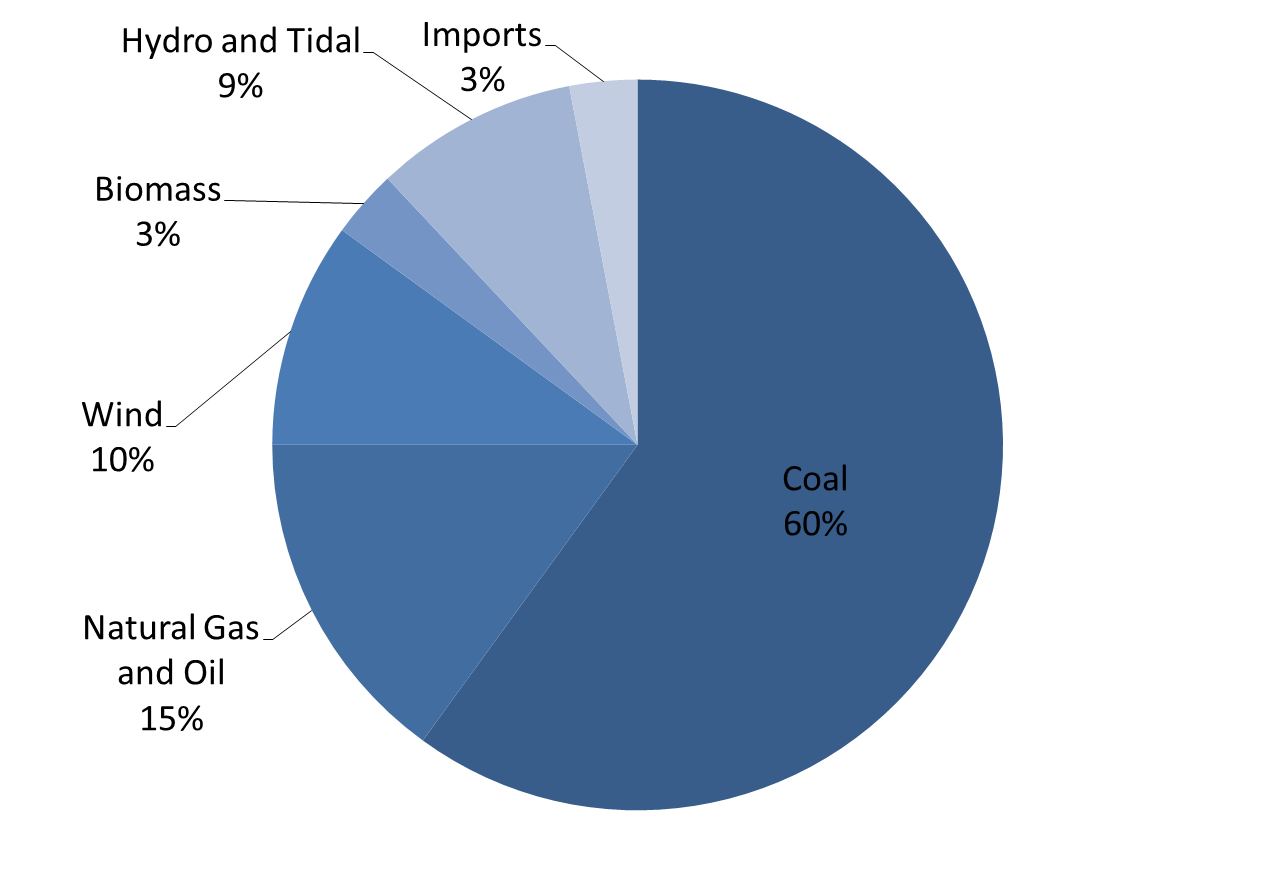
The above graph is taken from ICF's 2014 energy market report, and is their minimum growth forecast. If correct, Nova Scotia will generate around half of it's power from coal for the next 25 years! My prediction is that the future to 2020 is unlikely to be much better than ICF's forecast, however after 2020, cheap natural gas will start to play a bigger role in reducing power generation from coal.
ICF is forecasting increasing natural gas prices compared to what they were when the report was written. Their 2015 forecast was for around $4/mmbu a the henry hub, yet it is currently trading below $3/mmbtu. The report correctly states that the price paid for gas in the maritimes is tied to the price at the Dracut hub near Boston, MA. Due to limited pipeline capacity from natural gas producers in PA, the price is higher than the henry hub, especially in winter when it regularly peaks over $20/mmbtu. Heritage Gas is so convinced these winter price peaks will continue that it has entered into an agreement Alton Natural Gas Storage to build salt caverns to store gas for winter peak use.
Over the coming years, I expect these winter spikes to be significantly reduced, due to a number of factors. The first is new pipeline construction. The biggest is Kinder Morgan's Northeast Energy Direct pipeline which will bring over a billion cubic feet per day to the Boston area. The Constitution pipeline will bring up to 0.65 bcf/d of gas north from Marcellus wells in northeastern PA. A couple smaller projects will add around another .5 bcf/d of natural gas pipeline capacity to the Boston area.
The reason for these pipeline projects is not just because of unusually high prices in New England, but the combination of those high prices and unusually low prices in central Pennsylvania. This winter while prices around Boston were peaking over $20/mmbtu, prices at the Leidy hub stayed below $3, and are currently averaging $1.50/mmbtu. Pipeline builders could charge a tariff double the typical 50-75c/mmbtu and producers would gladly pay it in order to get their gas to markets. Energy companies like Cabot Oil and Gas have halted completion on many of their natural gas wells while they wait for new pipeline capacity to be built.
Another reason I expect natural gas prices in NS to average lower in the coming years has to do with how events on the other side of the world affect LNG prices. There are a number of LNG import facilities including Canaport that are able to provide extra gas supplies during the winter peak, but for the past few years they have imported very little. The reason is unusually high LNG prices following the Fukushima disaster made it unprofitable to import LNG. New production from LNG plants in Australia has cut LNG prices by more than half in the last year, with prices currently around $7/mmbtu. Additional LNG production from projects under construction in Australia and the US should push LNG prices in the Atlantic down to the $5/mmbtu range by 2020.
The combination of new pipelines and lower LNG prices should lead to Dracut natural gas prices below $6/mmbtu during the winter peak and around $3/mmbtu for the rest of the year. This will eventually lead to lower natural gas prices in Nova Scotia, which will provide the financial incentive for switching more generation from coal to natural gas. Lower natural gas prices should also mean Nova Scotia will use more power from Muskrat Falls when it is completed. Nova Scotia Power has locked in about 1.2TWh/yr of power from the project, and will be able to purchase another TW or so at market prices. Cheap natural gas in New England is pushing down electricity prices, so New England won't have to pay top dollar for power from Muskrat Falls. This should lead to Nova Scotia to purchase much of the surplus power, and at rates that should be significantly lower than the power it has locked in on a 20 year contract.
Thursday, March 12, 2015
Nova Scotia energy part 1: the present
It's clear from the above graph that the utilization of natural gas generation is less than coal. If they were used in proportion to their capacity, natural gas would account for 20% of generation and Coal would account for 50%. The likely reason for the under-utilization of natural gas capacity is due to the high cost of natural gas during the winter peak period. While I haven't found published information on the price Nova Scotia Power pays for natural gas, the regulated gas recovery rate charged by Heritage Gas should be a reasonable proxy. The winter 2014/2015 peak was $15/GJ, and the 2014 summer low was around $9/GJ. Compare this to the Henry Hub, where prices averaged below C$4/GJ this winter. The price of thermal coal is around US$50/st which, at around 20 million BTU per short ton, equates to an energy cost of US$2.50/mmbtu or around C$3/GJ.
So why is the price of gas in the maritimes up while at the same time going down in the US? Production from the Sable offshore energy project is less than half of what it was 5 years ago, and new production from deep panuke has not been enough to offset that drop. Meanwhile US production, primarily from the Marcellus shale, has increased.
As for renewable energy, wind has just made it into the double-digit percentages, but solar is non-existent. Although the cost of PV is approaching grid parity, the lack of a solar feed-in tariff has likely limited solar PV installations to primarily off-grid projects. Unlike Ontario where microFit pays about 40c/kWh, Nova Scotia is unlikely to see anything similar. The reason is that Nova Scotia's peak demand of 2GW is in the winter, while Ontario's peak demand is in the summer. A solar feed-in tariff in NS would just exacerbate this seasonal demand imbalance. The economics of solar PV has recently become worse, as import duties will likely increase the cost of PV panels in Canada.
In my next post I'll review Nova Scotia's energy plans and make some predictions for the future.
Sunday, February 22, 2015
2015 heating cost comparisons
Electric heating costs have not changed much, with the cost of electricity now 14.95c/kWh. This equates to a cost of 4.38c per thousand BTUs.
Furnace oil is now selling for 95c/L. In my previous calculations, I assumed a 90% efficient condensing boiler. These are uncommon in NS, so I'll use the 84% efficiency of an oil fired boiler with a tankless coil. This equates to a cost of 3.14c/kBTU. Pie anyone?
Instead of propane which is not commonly used for space heating in NS, I'll look at the cost of natural gas. The current price of natural gas is $20.69/GJ. When the $21.87 monthly charges is factored over my estimate of 42GJ/yr of gas consumption for a moderately energy-efficient residence, the total cost per GJ is $26.93/GJ. With one gigajoule equal to 948 kBTU, and an efficiency equivalent to an oil fired boiler, natural gas heat costs 3.38c/kBTU.
For wood pellets, prices have increased so that 40lb bags are selling for at least $5.50. I've also found out that wood pellet stove efficiency tops out at around 87%, and for typical units is closer to 75%. After updating my calculations based on the higher price and lower efficiency, wood pellet heat costs 2.29c/kBTU.
With the recent popularity of air-source heat pumps in Nova Scotia, it is prudent to compare their cost of heat to other sources. A high-efficiency unit with a COP of 2.4 will provide heat at a cost even lower than pellets - 1.83c/kBTU. A lower efficiency unit with a COP of 1.4 will provide heat for about the same cost as oil - 3.13c/kBTU.
Tuesday, December 30, 2014
Solar PV economics - approaching grid parity in Nova Scotia
Most of the solar power industry in Canada is focused on Ontario, due to the high subsidies under the microFit program. At 39c/kWh, a rooftop PV system is a no-brainer. The cost of the panels and an inverter to convert the DC power into AC adds up to about $1.50/kWh for a 8kW system. Installation costs can vary depending on how high and steep the roof is, however I think around $5000 for a 8kW system is a reasonable price. If a solar installation contractor wants to charge much more than that, I'd consider hiring a roofing contractor to mount the panels and an electrician to install the wiring and inverter.
Although the cost of solar panels has dropped by about 75% in the last five years, there has not been an equivalent reduction in the costs of inverters. Given the costs of the input materials - the solar wafers, glass, metal frames - I think PV panel costs will bottom out around 50c/W. With inverters, the technology still has room for significant improvements. Google's Little Box challenge is one example of incentives to improve inverter technology. Within the next five years, I expect the cost of grid-tie inverters to drop from over 50c/W to under 20c/W. This along with more competition on the PV installation market should bring the total installed cost including taxes of a residential PV system to under $1.50/W, compared to around $2.50/W now.
So at current prices, a 8kW system would have a total installed cost of about $20,000. How long that cost is amortized over has a big impact on the economics. Solar panel warranties are usually 25 years. Their efficiency drops over time as well; after 25 years about 80% of the installed efficiency is common. Warranties on inverters are much less - 5 or 10 years. For financing, the longest amortization for mortgages available in Canada now is 25 years. Therefore, I think a 25-year amortization makes the most sense.
Interest on a 10yr fixed mortgage with a 25 year amortization is about 4.4%, and the monthly payments on that mortgage would be $109/month. The PV pontential of most of Eastern Canada is around 1000kWh/kW. That means a 8kW system would generate about 8000kWh of electricity per year. With a cost of electricity of 15c/kWh, that would generate an average of $100 worth of electricity per month, almost covering the $109/mth costs of the system.
One caveat for Nova Scotia is that the current grid-tie tariff does not allow you to produce more electricity than you use. An energy-efficient house, unless it uses electric heat, would likely use less than 8000kWh of electricity per year. Smaller systems have less economies of scale, so a 5kW system would likely have a cost of $3/W. Grid parity may not be here yet in Eastern Canada, but it is coming soon.
Sunday, September 28, 2014
Mini split heat pumps
As with any type of heat pump, the bigger the temperature difference (called lift), the lower the efficiency of the heat pump. The efficiency rating for air-source heat pumps is usually given as a heating seasonal performance factors (HSPF). This is a seasonal average of BTUs of heat provided per watt of energy consumed. To convert HSPF to COP that is the usual performance rating for geothermal heat pumps, divide the HSPF by 3.4 - the number of BTUs per Watt.
HSPF by itself is not a useful performance measure, since it depends on the heating season outside temperature. If the unit does not specify the temperature for the HSPF, it is likely 8.3C (47F for those who don't think in metric). This might be a useful measure for someone living in Vancouver, BC, but not so much for someone living in Halifax, NS where the average January temperature is about -5C.
NrCan states:
At 10°C, the coefficient of performance (COP) of air-source heat pumps is typically about 3.3. This means that 3.3 kilowatt hours (kWh) of heat are transferred for every kWh of electricity supplied to the heat pump. At –8.3°C, the COP is typically 2.3.
Monday, June 24, 2013
Nuclear furnace for home heating
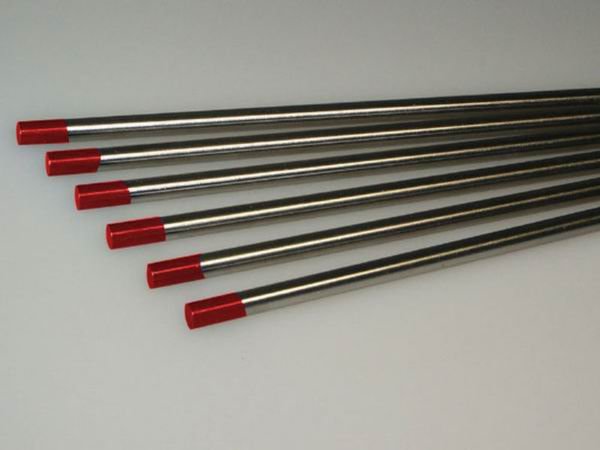
I had read about a kid who used lantern mantles as a source of thorium, but that seemed like too much work. Then I read about thoriated tungsten welding rods. A local welding supply shop sells a 10-pack of 2.4mm x 175mm rods for under $40. Each rod has a volume of 0.8cm^2, and .3g of Th. Based on the articles I've read on thorium reactors, the heat generated from the nuclear reaction of 1g of Th is 36 million BTUs. So if I can consume all the thorium from 10 rods (3g), I'd generate 108 million BTUs of heat, at a cost of under 40 cents per million BTUs.
In my post on costs of heating in NS, I calculated that heat from electricity costs a little over $40 per million BTUs. So the cost of heating with a thorium nuclear furnace should be about 100x cheaper than electricity! Besides thorium, the other thing I need to make a nuclear furnace is a neutron source. The liquid salt thorium reactor articles talk about using uranium-233, which I can't (legally) obtain. Ka-Ngo Leung and his colleagues in Berkeley Labs have invented a cheap way to generate neutrons, but it's not commercially available yet. The radioactive boy scout stories say he used radioactive americium-241 from smoke detectors as his neutron source. He wrapped it in aluminum, which absorbs the alpha particles from the americium and spits out neutrons. I'll try the same thing.
I also need a neutron moderator to slow down the neutrons so they'll be captured by the thorium atoms to start the nuclear reaction. Hydrogen, carbon, and to some extent oxygen all make good moderators. Candu reactors use heavy water, but that's hard to get and it's expensive. Most nuclear ractors use regular water. The radioactive boy scout used charcoal (carbon). Paraffin wax is mostly carbon and hydrogen atoms, and so makes a good moderator. I'd like to be able to easily remove the neutron source (to turn off the furnace). Paraffin wax would melt when the furnace heats up, so my first attempt will be to wrap the neutron source with some charcoal using some aluminum foil. I'll attach a wire, and drop the cylindrical neutron generator into a tube that is surrounded by the thoriated tungsten rods.
I'd love to hear from any physics heads on what the rate of the reaction should be. Protactinium-233, the decay product of Th-233 has a half-life of 27 days and beta-decays into U-233. So I'd guess it will take a couple weeks to approach full temperature.
Saturday, March 16, 2013
Heat Pump Hacking
The optimal amount of refrigerant in heat pumps (and air conditioners) depends on the temperatures of the cold and hot sides. I wanted to tweak the refrigerant charge, but R-22 is bad for the atmosphere and hard to come by. I came across some information on propane (r-290) as a refrigerant which indicated it can be used as a substitute for R-22. I can get it cheap at my local hardware store, and even Greenpeace likes it.
I read about people using propane for DIY computer cooling, and someone that recharged an R-22 system with propane. The first thing I needed was a manifold gauge set. They tend to sell for $100-150, but I found what I thought was a good deal on ebay for about $50. It has plastic handles on the valves, and one was broken on arrival. About a minute after I hooked it up to the high and low side schrader valves I heard a loud pop. It took several more minutes to figure out one of the hoses had burst and was leaking. Now I would HAVE to recharge the heat pump.
I had a gauge set (with 2 of 3 hoses still good), and a couple 16oz canisters of propane. Fuel-grade propane can have moisture in it which is supposedly bad for a heat pump. Instead of trying to buy refrigerant-grade propane (r-290), I decided to run the propane through a drier. I bought a drier with 3/8 copper sweat connections and a shrader valve at Wolseley (about $20 total). I bought a propane torch and unscrewed the tip. Here's my parts:
I cut the 1/4" copper tube off the schrader, then soldered it all together:
I hooked it up with a propane tank to my gauge set to check the pressure. The pressure was slow coming up, probably because the pinhole orifice in the propane torch was too small. I unsoldered the tip, drilled the pinhole out to 1/16", and then tested it to see how much more propane comes out:
I soldered my rig back together, and then hooked it up to my heat pump and started charging it from the low side. After a few minutes I turned on the heat pump, and was reading ~30psig on low side and the suction tube temperature about an inch away from the compressor was ~5C. That was about 20C of superheat - much higher than what it should be for optimal efficiency. After a few more minutes I had gone through about 400g of propane and my low side pressure was 40psig, with the suction tube temperature around 0C. The antifreeze mix coming out of the heat pump was -8C; right around the evaporation temperature of propane at 40psig. I'll do some more performance measurements later; for now the heat pump is working OK.
Wednesday, December 5, 2012
Heating cost comparisons
Electric baseboard heaters are cheap to install, but expensive to use. The current cost of electricity in NS is 14.6c/kWh tax in. With one kWh of electricity providing 3412 BTU of heat, electric heating costs 4.28c/kBTU.
If you use the time-of-day tariff, off-peak electricity costs 8.15c/kWh tax in. That reduces electric heating costs at night and weekends to 2.39c/kBTU.
Furnace oil is selling for $1/L, and provides ~36kBTU when burned. With a 90% efficient condensing boiler, the cost is 3.09c/kBTU.
Discount propane sells for ~60c/L at Costco, and provides ~26kBTU when burned. With a 90% efficient condensing boiler, the cost is 2.56c/kBTU.
Wood pellets provide ~8kBTU/lb, and sell for ~$5 for a 40lb bag. At 90% efficiency, the cost of heat is 1.74c/kBTU.
Heating with wood pellets is pretty cheap, but still not the cheapest. A geothermal heating system will have a COP of at least 3.0 (4.0 can be achieved with new high-efficiency heat pumps). Take the 4.28c/kBTU cost of electricity and divide by the COP (3.0) to get a heating cost of only 1.43c/kBTU. With a time-of-day tariff and off-peak use, the rate is just 0.8c/kBTU.
Don't forget the cheapest (free) source of heat - the sun. So on those sunny winter days, open the curtains, raise the blinds, and let the sun shine in!
Friday, November 11, 2011
Eco Cars
The Mitsubishi i-MIEV will sell for $33K, at a claimed 1c/km for electricity. Total driving cost: $200.
The Prius is $28K and has a fuel economy of 4.0L/100km. Total driving cost: $1000.
The Kia Rio 5 is $14K and has a fuel economy of 4.9L/100km. Total driving cost: $1225.
Dividing the cost of the vehicle over 10 years (excluding financing & maintenance costs) puts the Rio5 on top:
Prius: $3800/yr
i-MIEV: $3500/yr
Rio5: $2660/yr
I often drive a motorcycle in good weather, so for fun I calculated the annual cost for a Honda Shadow 750: $1975. A smaller CBR125R: $1050.